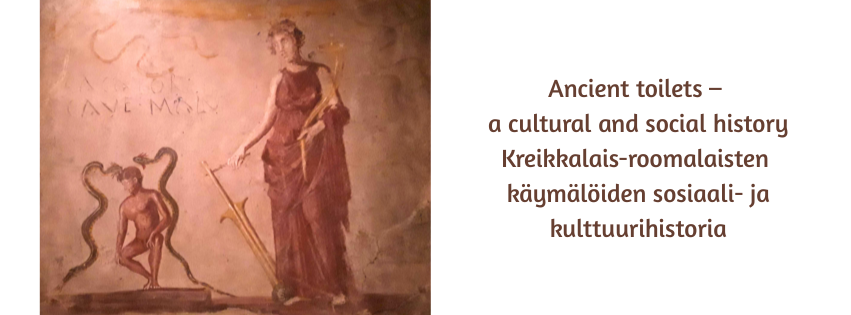
New project, Ancient toilets – a cultural and social history, Kreikkalais-roomalaisten käymälöiden sosiaali- ja kulttuurihistoria in Finnish, is about to start!
Project researcher Dr. Saara Kauppinen begins her work in February 2026, and PI Laura Nissin will join her in April.
The project is generously funded by the Kone Foundation.
Introduction
Latrines are invaluable archives for researchers studying the past. As the authors of Rubbish: The Archaeology of Garbage aptly note, [g]arbage is among humanity’s most prodigious physical legacies to future generations (Rathje and Murphy 2001, 4). The waste preserved in ancient latrines offers unique insights into daily life that other archaeological contexts simply cannot provide. While the architectural and archaeological features of Greek and Roman toilets have received some attention in recent decades, there remains a notable gap in comprehensive historical studies on ancient sanitation.
Moreover, existing research on the material culture of these toilets often relies on biased assumptions about their function and the smells associated with them. Much of the scholarship on ancient sanitation perpetuates the idea that Graeco-Roman cities were inherently foul-smelling due to their use of cesspits rather than sewers. This perspective is heavily influenced by modern (Western) preferences for sewage systems, which prioritize the removal of waste from private homes (cf. Jansen 2018; Nissin 2022). However, this emphasis reflects contemporary values rather than historical realities.
Additionally, previous studies have often claimed that human waste was ubiquitous in ancient cities, with people defecating outdoors and emptying chamber pots directly into the streets. Yet, there is little concrete evidence to support this dramatic portrayal of waste accumulation in urban spaces. These assertions are largely based on superficial interpretations of a limited number of literary sources. Reevaluating these assumptions is crucial for gaining a more nuanced understanding of historical urban environments and the lived experiences of their inhabitants.
Hence, our project will investigate toilets and their role in waste management and sanitation in the ancient Greek and Roman world, from a new perspective, for a holistic comprehension of the sanitation practices of Graeco-Roman antiquity. As such, it will be the first comprehensive historical study of Greek and Roman toilet culture.
The project will undertake a source-critical textual analysis of ancient Greek and Roman literature and epigraphy, investigating the aspects of uses and users of latrines in the association of smellscapes, and other sensory aspects of sanitation, waste management, and socio-spatial and architectural aspects discussed in the texts. The research also asks what kind of values and attitudes the ancient Mediterraneans associated with toilets and ordure, and how (human) waste was managed in the domestic and urban areas and agriculture. Additionally, the uses of ordure in medicine and magic are investigated.
The team
The team consists of two experienced researchers, who will be responsible for their own areas of research.
Dr. Laura Nissin (PI) will work with the Latin literature and epigraphy and will also execute the literature review of previous archaeological research. She holds the title of Docent in Latin language and Roman literature and has vast experience in research into ancient cultural history and archaeology of the Roman world.
Dr. Saara Kauppinen will work with the Greek material, mainly literature and epigraphy. She will also assist on selecting and reviewing the archaeological research of the Greek sanitation and lavatories. She has a PhD in Greek language and literature, and specializes in Greek epigraphy, but also has vast experience of both Greek and Latin literature, social history, and material aspects of the Graeco-Roman world, including Greek archaeology.
References:
Jansen, G. 2018. “Sewers or cesspits? Modern assumptions and Roman preferences.” In Latrinae: Roman Toilets in the Northwestern Provinces of the Roman Empire, ed. S. Hoss, 5–18. Oxford: Archaeopress.
Nissin, L. 2022. “Smellscape of a Pompeian neighborhood.” Journal of Roman Archaeology.
Rathje, W. L., and Murphy, C. 2001. Rubbish! The Archaeology of Garbage. Tucson, AZ: University of Arizona Press.
RESEARCH PLAN (available on request)